Long-Term Car Storage
Leaving Auckland for six weeks and working out what to do with the car is one of those problems that sounds simple until you price it. Auckland Airport long-stay parking at full rate for a month and a half would cost you more than most domestic flights. Dedicated storage facilities exist, but finding one that is actually secure, reasonably priced, and still operating when you get back requires more homework than most people expect. Here is a straightforward look at every option available in Auckland, from the airport’s own lots through to leaving it in your mate’s garage with the battery disconnected.
Airport Long-Stay Lots
What the Airport Actually Offers for Extended Stays
Auckland Airport’s long-stay parking is the outdoor lot — uncovered bays in a large surface car park connected to the terminals by a free shuttle bus. The shuttle runs every 10-15 minutes during operating hours, and the ride takes about five minutes. It is functional, if not glamorous.
Pricing for the long-stay lot is dynamic and tiered. Pre-booked online rates start at around $12-16 per day, but the per-day cost drops slightly the longer you stay. A two-week booking might work out to $10-12 per day pre-booked, putting a fortnight at roughly $150-170. Walk-up rates are higher — typically $18-22 per day — and there is no multi-day discount, which makes spontaneous long-stay parking at the airport an expensive mistake.
For stays beyond two weeks, the airport’s pricing flattens but does not cap. A month in the long-stay lot runs $300-400 depending on when you book and the time of year. That is a meaningful chunk of money to leave a car sitting in an uncovered lot exposed to Auckland weather for 30 days.
The practical reality of a car parked outdoors at Auckland Airport for a month: expect dust, possible bird droppings baked into the paint, surface water marks if it rains, and a flat battery if your vehicle has any electrical drain. The lot is monitored by CCTV and patrols, but it is a large open area and break-ins, while uncommon, are not unheard of. Remove everything of value. Then remove the things you did not think had value but that someone might smash a window for anyway.
Off-Site Airport Parking Operators
The off-site operators around Mangere and Airport Oaks are where long-term airport parking starts to make more financial sense. Operators like Park & Fly, Best Flights Parking, and several smaller businesses offer rates that undercut the airport’s own long-stay lot, particularly for stays of two weeks or more.
Typical pre-booked rates at off-site operators run $8-12 per day for uncovered bays, with covered options available at a small premium. A month-long stay might cost $200-280, saving you $100+ over the airport’s own lot. Some operators offer flat weekly or monthly rates that simplify the pricing — $60/week or $200/month is not uncommon.
The trade-off is the shuttle transfer. You drive to the operator’s facility, park, and wait for a shuttle to take you to the terminal. On return, you call from the arrivals area and wait for the shuttle to collect you. Each transfer adds 15-25 minutes to your airport journey, and the quality of the shuttle service varies. Some operators run dedicated vehicles on a tight schedule. Others use a minivan that shows up when the driver finishes his cigarette.
For extended stays, the shuttle inconvenience is a one-time cost on each end of your trip — a total of maybe 40 minutes across the entire month. The financial saving over that month makes it a rational trade for most people. But read recent reviews before you book. The operator that was excellent last year may have changed hands, and a month is a long time to leave your car with a business you have not vetted.
Dedicated Vehicle Storage Facilities
Indoor Storage Around Auckland
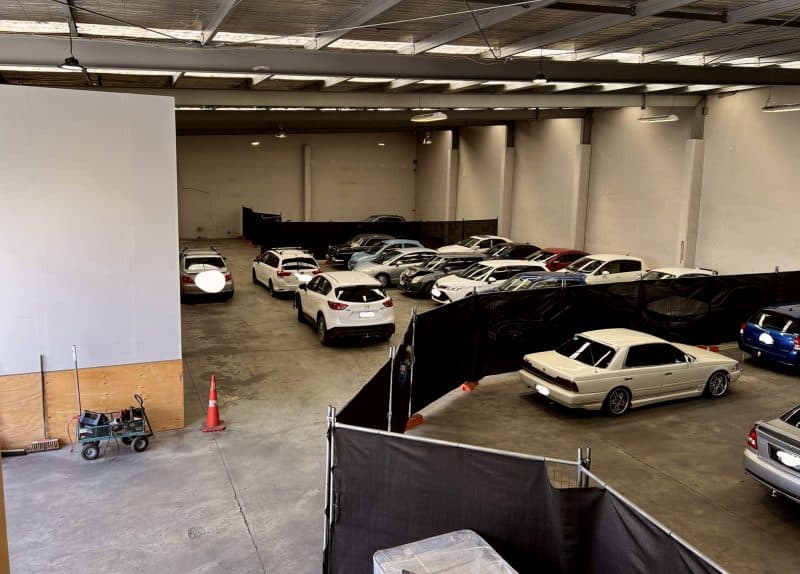
Dedicated vehicle storage is a different market from airport parking. These are facilities designed for people who need to store a car for weeks to months — not just the duration of a holiday, but potentially while they are overseas on an extended contract, between houses, or storing a vehicle they do not use daily.
Auckland has several dedicated storage options, concentrated in industrial areas like East Tamaki, Penrose, Onehunga, and out near the airport in Mangere. National Storage and Kennards Self Storage both offer vehicle storage at selected locations — either in dedicated vehicle bays or in large lock-up units that fit a car. Smaller operators run purpose-built facilities with indoor bays, some climate-controlled, some not.
Indoor storage means your car is fully enclosed — protected from weather, UV, dust, and the general deterioration that comes from sitting outside for months. The better facilities have controlled access (keypad or swipe card), CCTV, and concrete floors that prevent the moisture issues you get with gravel or dirt surfaces. Some offer power outlets so you can leave a battery trickle charger connected, which is a genuine advantage for extended storage.
The catch is access. Unlike airport parking where you drive in and out freely, dedicated storage facilities may have restricted access hours — typically business hours on weekdays, with limited or no weekend access. If you need to collect your car on a Sunday evening because your flight landed early, check the facility’s access policy before you sign up.
What It Costs for Weeks and Months
Dedicated vehicle storage in Auckland typically runs $40-80 per week for an indoor bay, depending on the facility, the size of the vehicle, and whether you want additional services like a trickle charger or periodic engine starts. Monthly rates are usually discounted from the weekly rate — expect $120-250 per month for a standard-sized car in an indoor facility.
Compared to airport parking, the savings are significant for extended stays. A month at the airport’s long-stay lot costs $300-400. A month in a dedicated storage facility costs $120-250 — and your car is indoors, not sitting in a field next to a runway. For a three-month overseas posting, the difference could be $500-1,000.
Some facilities offer long-term contracts with further discounts — three months prepaid, six months prepaid, or even annual rates for vehicles that are being stored indefinitely. If you know the duration of your absence, a prepaid contract is usually the best value.
The additional cost to consider is transport to and from the facility. Unlike airport parking, a storage unit in East Tamaki does not have a shuttle to the airport. You will need to arrange your own transport — a taxi, a rideshare, or a helpful friend — to get from the storage facility to wherever you need to be. Factor that cost into the comparison. Even with a $50 taxi each way, dedicated storage is usually cheaper than airport parking for stays beyond two weeks.
What to Ask Before You Sign Up
Before you hand over your car and your money, ask these questions. They separate the professional facilities from the ones operating out of a mate’s warehouse.
What are the access hours? If you can only collect your car between 8am and 5pm on weekdays, that is a problem for most travellers returning on evenings or weekends. Some facilities offer 24/7 access via keypad — verify this before you book.
What security is in place? CCTV, controlled entry, on-site staff, alarm systems — ask specifically. “The property is secure” is not an answer. “We have CCTV on all entry points, keypad-controlled access, and an alarm system monitored by a security company” is an answer.
Is the facility insured, and what does it cover? The facility’s insurance covers the building, not your car. Your own vehicle insurance needs to cover the car while it is in storage. Check with your insurer that your policy covers storage at a third-party facility — some policies have restrictions on where the vehicle can be left long-term.
What is the contract term and cancellation policy? If you are paying month-to-month, can you cancel with a week’s notice? If you prepaid three months and return after six weeks, do you get a refund? Understand the terms before you sign.
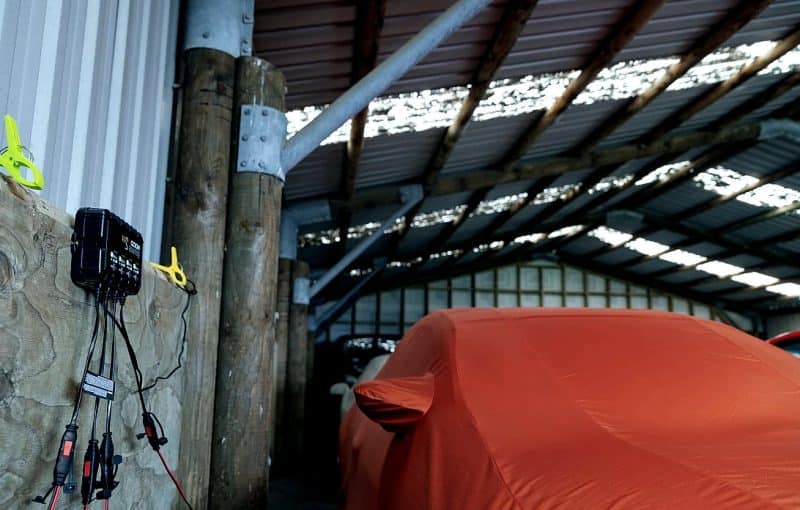
Can you leave a trickle charger connected? If the facility has power outlets at each bay, this is a significant advantage for long-term storage. A flat battery is the most common problem with stored vehicles, and a trickle charger prevents it entirely.
What condition should the car be in when you drop it off? Some facilities require a minimum fuel level, clean interior, or that the vehicle is registered and warranted. Ask so you are not turned away on drop-off day.
Preparing Your Car for Extended Storage
Battery, Tyres, and Fluids
The three things that go wrong with a stored car are predictable and preventable: the battery dies, the tyres develop flat spots, and the fluids degrade. Address all three before you lock the door and walk away.
Battery: A car battery will self-discharge over four to six weeks, faster in cold weather or if there is any parasitic electrical draw (alarm systems, dashcams, clock displays). The best solution is a trickle charger (also called a battery maintainer) connected to mains power. If that is not possible, disconnect the negative terminal before you leave. You will need to reset your clock and radio presets when you reconnect, but the battery will hold its charge significantly longer.
Tyres: A car sitting stationary for more than a month can develop flat spots on the tyres where the weight rests. Inflate the tyres to the maximum pressure listed on the tyre sidewall (not the vehicle’s recommended pressure, which is lower) before storage. This reduces the contact patch and minimises flat-spotting. If you are storing for three months or more, consider putting the car on jack stands to take the weight off the tyres entirely.
Fluids: Top up the fuel tank to reduce the air space where condensation forms — a full tank is better than a quarter tank for long-term storage. Check the oil level and coolant level. If you are due for an oil change within the next 1,000km, do it before storage rather than after — old oil contains contaminants that become more corrosive sitting in the sump for months.
Wash the car before storage. Dirt, bird droppings, and road grime left on the paint for weeks will etch into the surface, and you will return to stains that require polishing to remove. A clean car stores better than a dirty one.
Insurance and Registration While You Are Away
Your car insurance does not pause just because you are overseas. Most comprehensive policies continue to cover your vehicle for fire, theft, and natural disaster while it is stored, but check with your insurer that the policy covers the specific storage location. Some policies have conditions about where the vehicle must be kept — “at the insured’s residential address” might not include a commercial storage facility in East Tamaki.
If your insurance is due for renewal while you are away, arrange it before you leave. Letting your policy lapse and relying on renewing it when you return is a gamble. If anything happens to the car during the gap in cover, you are uninsured. Most insurers will process a renewal over the phone or online even if you are overseas.
Some insurers offer a reduced premium for stored vehicles — a “laid-up” or “non-use” policy that covers the car while it is stationary but not for road use. This can save 30-50% on your premium during the storage period. Ask your insurer whether this is available and what restrictions apply.
Vehicle registration (rego) in New Zealand can be purchased for 3, 6, or 12 months. If your rego expires while you are away and the car is genuinely not being used on public roads, you can let it lapse — there is no legal requirement to register a vehicle that is stored on private property. However, you will need to re-register and get a new WoF before driving the car on public roads when you return. Budget time for this in your return plans, because you cannot legally drive the car from the storage facility to the mechanic without current rego and WoF.
The DIY Options
Leaving It at Home or at a Friend’s Place
The cheapest car storage option is the one that costs nothing: your own garage, your own driveway, or a favour from someone you trust. And for many Auckland travellers heading overseas for a few weeks, this is the obvious and correct answer.
Your own garage is the ideal scenario. The car is covered, on your property, and you control the environment. Leave the trickle charger plugged in, inflate the tyres, and the car will be fine for months. The only risk is something happening to your property while you are away — a break-in, a flood, a tree through the roof — and your home insurance typically covers the vehicle in those scenarios.
Your own driveway is the next best option, with the caveat that the car is exposed to weather and visible to anyone passing by. Auckland council bylaws allow registered vehicles to be parked on residential property for extended periods, but an obviously unattended car — gathering dust, with junk mail piling up on the windscreen — can attract attention from both thieves and neighbours. Ask someone to check on it periodically, move it slightly to prevent flat spots, and clear any letterbox overflow.
A friend or family member’s place is free but comes with social costs. You are asking someone to host your car on their property for weeks or months. If their driveway is tight, your car is an inconvenience. If something happens to it on their property — a neighbourhood kid puts a ball through the windscreen, a tree drops a branch — the social dynamic gets uncomfortable fast. Be explicit about expectations, insurance coverage, and what happens if there is damage. A casual “yeah, just leave it here” is fine for a weekend but insufficient for two months.
Making the Storage Decision
The storage decision comes down to four variables: how long you are away, what the car is worth, what you are willing to spend, and how much hassle you will tolerate on either end.
Under two weeks: Airport parking (covered or outdoor) or your own garage. The convenience of having the car at the airport when you land is worth the cost for a short trip, and the total spend is manageable. If you have a garage at home and someone who can drop you at the airport, that is even cheaper.
Two to six weeks: This is the awkward middle ground. Airport parking is expensive for this duration, but dedicated storage adds logistical complexity. If you have a garage, use it and take a taxi to the airport. If you do not, an off-site airport parking operator or a dedicated storage facility is usually the best value. Compare the total cost (storage + transport to and from the facility) against the airport’s own long-stay lot.
Six weeks to three months: Dedicated storage facilities win on cost. The monthly rate at a good facility is half or less than the airport, and your car is indoors. The transport logistics are a one-time hassle on each end — a taxi or a favour from a friend. Budget $100-200 per month for storage and consider it a fixed cost of your trip.
Over three months: Seriously consider whether you need to keep the car at all. If you are heading overseas on a contract and the car will sit idle for six months or a year, the combined cost of storage, insurance, and registration may approach the car’s depreciation. For lower-value vehicles, selling before you leave and buying when you return can be the financially rational choice — even if it feels drastic.
Every long-term storage decision is really a bet on how much hassle you are willing to accept on the other end. The expensive option — airport parking for a month — buys you zero hassle and a very large bill. The free option — a mate’s driveway — costs nothing and occasionally costs everything. Somewhere in between, there is a dedicated facility with a locked gate and a reasonable monthly rate that lets you board your flight without thinking about the car again until you land. For most Auckland travellers heading away for more than a couple of weeks, that middle ground is where the answer sits.
2 Comments
Good tip about the battery maintainer. I left my car at a mate’s place in Pukekohe for six weeks and came back to a completely dead battery. Cost me $250 for a new one. A $50 trickle charger would have saved me.
Does anyone know roughly what the indoor warehouse storage places charge per month? Looking at storing a classic car over winter.